Balancing Forces 1
When dealing with a force diagram where there is no acceleration, it is possible even with very limitted information to find out all the forces acting on an object, because of the fact that the forces must balance in both directions. This homework will guide you through the process of solving two fairly complex problems.
1. Birdfeeder hung by wires
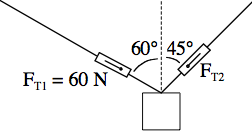
A birdfeeder is being suspended by two wires, as shown in the diagram to the right. The left wire is at an angle of 60° away from the horizontal; the right wire is at an angle of 45°. The tension force in the left wire (call this FT1) is 60 N.- Draw the force diagram for this situation.
- What is the vector form of FT1?
- You now know something about one of the components of FT2. Which component? What is it equal to?
- How strong is FT2?
(That is, how long is the whole vector - the hypotenuse)
- What is the full vector form of FT2?
- What is the weight
 of the birdfeeder?
2. Dog on a leash
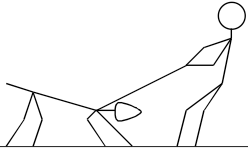
A man is pulling on his dog's leash, at an angle of 70° from the vertical. The man is pulling with a force of 70 N. However, the dog refuses to move; it plants its feet firmly on the ground and leans back to keep itself in place. The weight of the dog is 100 N.- What force is the dog relying on to keep it from moving forward?
- Draw a force diagram for this situation. There should be four forces in your diagram.
- What is the vector form of the tension force?
- What is the normal force?
- If the dog succeeds in staying put, what do we know about the coefficient of static friction?
Answers (part 1):
2)  1 = (-60sin(60)
 + 60cos(60)
 ) = (-52 + 30) N
3) The component of 2 balances the component of 1; it must be equal to 52 N.
4) sin(45) = 52/FT2 -> FT2 = 73.5 N.
5) The component is 73.5cos(45) = 52. 2 = (52 + 52) N
6) 1 + 2 + = 0 -> -52 + 30 + 52 + 52 + = 0 -> = -82 N.
Answers (part 2):
1) Friction.
3) = (70sin(70) + 70cos(70)) = (65.8 + 23.9) N
4)  plus the component of tension balance out . So, + 23.9 - 100 = 0 -> = 76.1N
5) The friction force has to be at least 65.8 N, so μs is at least 65.8 / 76.1 = .865.